
In an era where internal recruiters spend an average of six seconds on an initial resume screen, learning how to write a cover letter that bypasses the “delete” key is a critical executive skill. For the seasoned professional, a generic, long-winded document is a liability; however, a strategic case for candidacy is the most effective way to move your application to the top of the “must-interview” pile.
The secret to how to write a cover letter in today’s market isn’t about following a static template. It’s about transitioning from a formal applicant to a high-impact consultant who addresses a company’s specific needs before even stepping into the room.
How to write a Cover Letter
1. The “Hook”: Lead with a Business Solution
Most professionals start with: “I am writing to apply for…” This is a wasted opportunity. By the time a human reads your letter, they already know what role you applied for.
Instead, open with a “hook” that proves you understand their current landscape.
- The Pivot: “As [Company Name] prepares to navigate the upcoming regulatory shifts in the fintech sector, the need for an operations lead who has scaled compliant infrastructures is paramount.”
- The Result: You have immediately signaled that you are a consultant coming to solve a problem, not a candidate seeking a paycheck.
2. The Anatomy of a High-Impact Cover Letter
For a seasoned professional, brevity is a sign of authority. A document that actually gets read follows a lean, four-paragraph structure:
| Section | Content Strategy | Goal |
| The Hook | Address a specific company challenge or recent win. | Immediate engagement. |
| The Evidence | 2–3 bullet points of contextual proof (metrics + logic). | Validate your value proposition. |
| The Cultural Bridge | Connect your leadership philosophy to their mission. | Demonstrate strategic fit. |
| The Call to Action | A confident, professional nudge toward a conversation. | Move the needle to the interview. |
3. Use “Visual Anchors” for Scannability
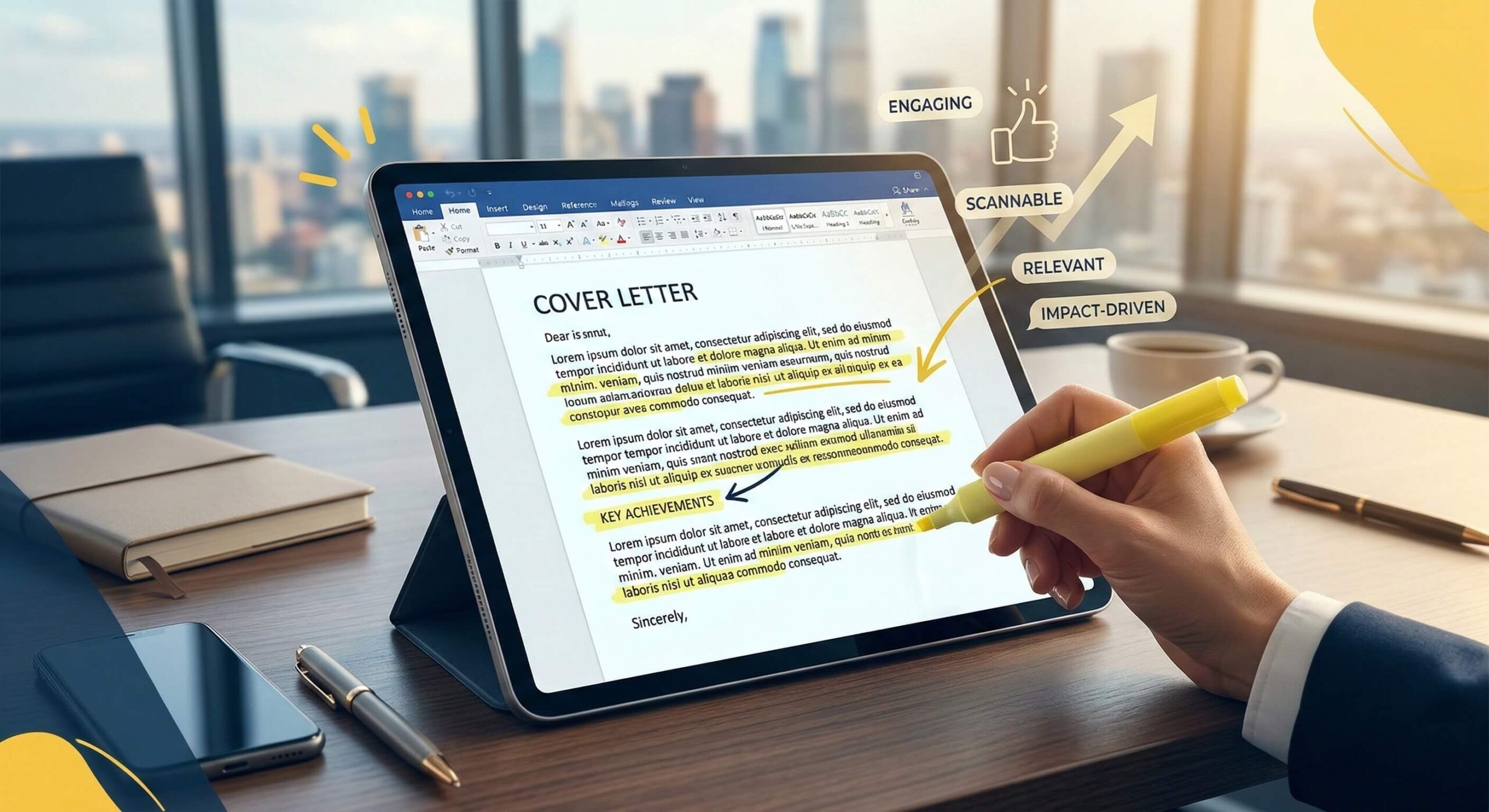
Recruiters and hiring managers don’t read; they scan. If your cover letter is a “wall of text,” it will be ignored. To ensure your key points are seen, use visual anchors:
- Bold Key Terms: Use bolding for specific achievements or high-value keywords.
- Bulleted Achievements: Instead of explaining a project in a paragraph, use a bullet: “Spearheaded a cross-functional merger that reduced operational overhead by 15% within the first six months.”
- White Space: Keep paragraphs short—no more than 3–4 lines.
4. Bypassing the Digital Gatekeeper (ATS Optimization)
To get read by a human, you must first survive the Applicant Tracking System (ATS).
- Mirror the Language: Look at the job description. If they use the term “Stakeholder Management,” don’t change it to “Client Relations.”
- Standard Formatting: Avoid complex tables or unusual fonts that can “break” the ATS parsing logic. Stick to clean, professional layouts.
- The PDF Rule: Always save your document as a PDF to ensure your formatting remains intact across all devices.
5. The Closing: The “Next Steps” Mindset
End your letter with an assumption of value. Avoid passive phrases like “I hope to hear from you.”
Try a more proactive approach:
“I am eager to discuss how my experience in scaling remote teams can support [Company Name]’s 2026 growth targets. I look forward to the possibility of an introductory conversation.”
Expert Checklist for Final Review
Before you hit “send,” ask yourself:
- [ ] Did I mention a specific company pain point?
- [ ] Is it under 300 words?
- [ ] Did I use at least two impact-driven metrics?
- [ ] Does the tone match the company’s brand (e.g., “Corporate Professional” vs. “Agile Tech”)?
Power Opening Lines Cheat Sheet
Power Opening Lines Cheat Sheet categorized by industry. These are designed to instantly signal that you aren’t just looking for a job you are providing a solution.
1. Technology & SaaS
Focus: Scalability, efficiency, and digital transformation.
“With [Company Name] currently navigating a rapid scaling phase following your Series C funding, the internal infrastructure requires more than just management—it requires an architectural overhaul. Having orchestrated the migration of legacy systems for a $50M ARR firm, I am eager to apply my problem-solving logic to your current integration hurdles.”
2. Finance & Investment
Focus: Risk mitigation, ROI, and stakeholder trust.
“In a market defined by shifting regulatory landscapes, the purpose of a cover letter for a Senior Finance lead is to demonstrate fiscal stewardship. My record of leveraging predictive analytics to reduce operational risk by 22% aligns directly with [Company Name]’s commitment to long-term value propositions for your shareholders.”
3. Healthcare & Pharmaceuticals
Focus: Compliance, patient outcomes, and innovation.
“As the healthcare industry moves toward value-based care models, [Company Name]’s recent pivot into telehealth puts you at the forefront of patient innovation. I have spent the last decade pioneering clinical workflows that bridge the gap between high-tech delivery and high-touch patient care—a strategic fit for your current expansion goals.”
4. Creative & Marketing
Focus: Brand narrative, market share, and human connection.
“Brands no longer compete on product alone; they compete on the strength of their narrative thread. Having transformed the digital presence of three Fortune 500 lifestyle brands, I am drawn to [Company Name]’s unique voice and am prepared to scale your global reach while deepening local cultural alignment.”
Expert Tip: The “Why You” Test
When choosing an opening line, ask yourself: Could any other candidate say this? If the answer is yes, make it more specific. Use the contextual proof of your past wins to make your opening undeniable.
Final Summary Checklist
| Industry | Key Driver | Power Word to Use |
| Tech | Growth/Efficiency | Automated |
| Finance | Security/Yield | Mitigated |
| Healthcare | Quality/Safety | Standardized |
| Creative | Engagement/Identity | Revitalized |
To conclude, mastering how to write a cover letter is the ultimate differentiator for any seasoned leader navigating a crowded market. By shifting from a standard summary to a high-impact executive summary, you demonstrate the strategic alignment and value proposition that digital resumes often fail to convey. Remember, the goal isn’t just to fill a seat, but to prove you are the solution to a company’s specific business pain points. When you combine narrative control with contextual proof, you move beyond being a mere applicant and become the inevitable strategic fit for the role.