
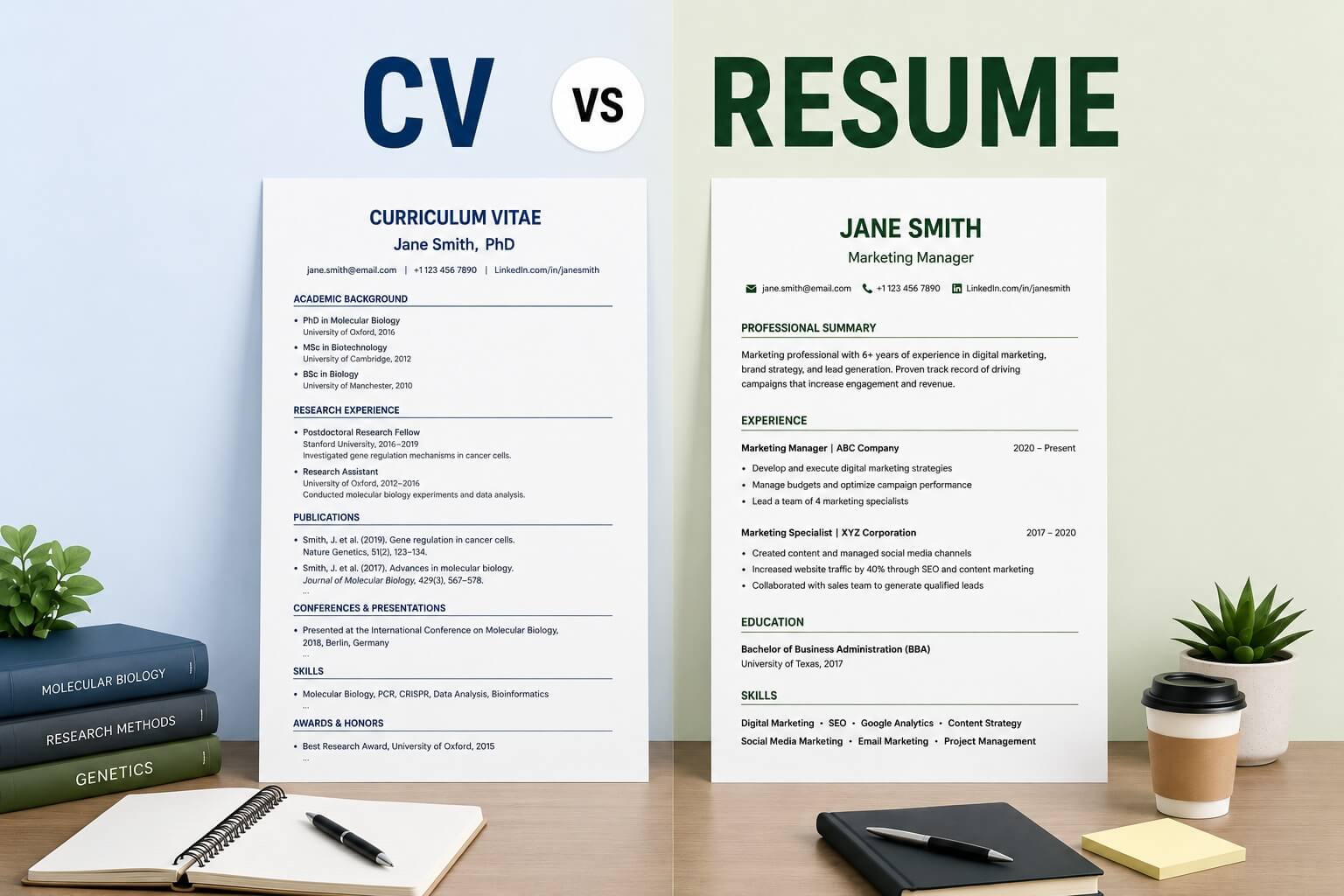
CV vs resume which one should you send? If you have ever applied for a job internationally, or even switched industries within the same country, you may have encountered both terms and wondered whether they refer to the same thing. The CV vs resume difference is real, and understanding it can save you from a costly application mistake. Here is everything you need to know about which document to use, when, and why.
The Core CV vs Resume Difference
A CV (Curriculum Vitae) is a comprehensive document covering your full academic and professional history. It has no strict page limit and can run to several pages for senior academics, experienced professionals, or individuals with extensive publication and conference records. A resume is a shorter, highly targeted document typically one to two pages tailored to a specific role. It prioritises relevance over completeness.
The CV vs resume difference is therefore not just about length it is about purpose. A CV is a record; a resume is a pitch. According to Prospects.ac.uk, the UK’s leading graduate careers resource, a CV should showcase everything relevant to a hiring decision, while a resume is purpose-built for a single application.
When to Use a CV
Use a CV when applying for academic positions, research roles, grants, fellowships, or medical and scientific posts. In these contexts, the reader expects and needs a full record of your publications, presentations, awards, academic appointments, and research projects. Completeness is a virtue here, not a flaw.
Outside academia, a CV is the standard document across much of the UK, Europe, the Middle East, and Africa, where the term simply means the document you submit for a job equivalent to what Americans call a resume. If a UK employer asks for “your CV,” they want the equivalent of a US resume: a focused, well-structured professional document, not a full academic record.
When to Use a Resume
In the United States and Canada, the word “resume” is the default term for the job application document. American employers typically expect a one-to-two-page document focused on your most relevant experience and achievements not an exhaustive career history. If you are applying to US companies, lead with a resume mindset: tight, targeted, results-focused, with every line chosen for relevance to the specific role.
The same applies to Australian and New Zealand employers, who generally use “resume” as the preferred term and expect the same concise, targeted format.
Regional Conventions at a Glance
UK and Europe: “CV” is the standard term. Two pages is typical for most professional roles. A professional photo is common in many European countries but should be avoided for UK applications. See our detailed guide on whether to use a photo on your CV for country-by-country guidance.
United States and Canada: “Resume” is standard. Keep it to one or two pages. Do not include a photo, date of birth, or marital status US employers are legally cautious about this information and its inclusion can trigger unconscious bias concerns.
Middle East and Africa: “CV” is the common term. Personal information including nationality and a professional photo is often expected, depending on country and sector. Research local norms carefully before applying.
International Applications: What to Do When You Are Unsure
When applying internationally, always research the conventions of the specific country and sector first. Understanding the difference between a CV vs resume is also important, as some countries and industries use the terms interchangeably while others expect very different document formats and levels of detail. When genuinely unsure, a clean two-page professional document without unnecessary personal details, without a photo, and with a clear structure of professional summary, work experience, education, and skills tends to travel well across most markets.
The safest default for international applications is a clean, structured, two-page document that reads as a strong professional summary and does not include anything that could introduce bias or trigger compliance concerns in an unfamiliar market. For guidance on CV length by career stage, see our dedicated guide on how long your CV should be.
CV vs Resume: Which Performs Better With ATS?
Both CVs and resumes must pass through applicant tracking systems in most modern hiring processes. In the CV vs resume discussion, one of the biggest misconceptions is that ATS requirements differ significantly between the two. In reality, the formatting rules are largely identical regardless of what you call the document: use standard fonts, avoid text boxes and tables, keep critical information out of headers and footers, and use conventional section headings. What matters most to ATS software is structure, readability, and keyword alignment not whether the document is labelled a CV or a resume.
For a thorough breakdown of how to make any application document ATS-compatible, see our guide on how to optimise your CV for applicant tracking systems in 2026.
Create the Right Document for Your Market
Whether you need a CV or a resume, SmartCV Builder has you covered. Choose the format and template that fits your target market, and our builder guides you through every section ensuring the right content, the right length, and the right layout for wherever you are applying. Build your CV or resume with SmartCV today.