
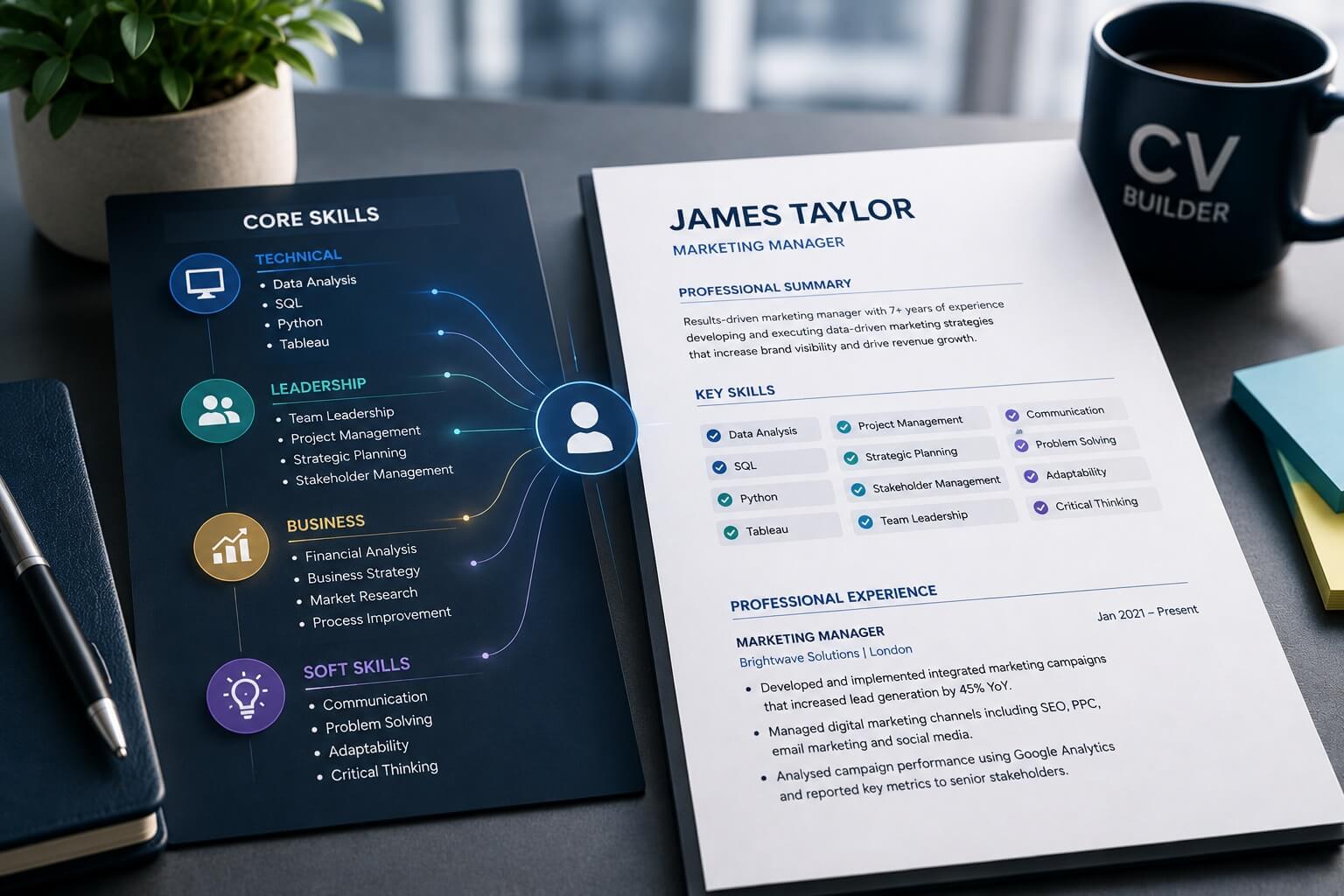
The CV skills section is one of the first things a recruiter scans, and often the part that decides whether your application moves forward or lands in the rejection pile. Done well, it tells a hiring manager in seconds that you can do the job. Done badly, it reads like a random word cloud that nobody believes.
Most applicants treat this part of the page as an afterthought, listing every tool and trait they can remember. The result is a tired, generic block that fails both the software and the human reading it. The good news is that a sharp, well-targeted skills list is straightforward to build once you know what employers actually look for.
These seven tips will help you create a section that earns attention, passes automated screening, and gives interviewers a reason to call.
Why the CV Skills Section Carries So Much Weight
Recruiters rarely read a CV top to bottom on the first pass. They skim for relevance, and skills are an instant signal of fit. A clear list lets them confirm in moments that you meet the core requirements.
Behind the scenes, applicant tracking systems search your document for specific terms before a person ever sees it. If the right keywords are missing, your application can be filtered out automatically. A strong skills section serves both audiences at once.
Balancing Hard Skills and Soft Skills
Hard skills are teachable, measurable abilities such as financial modelling, SQL, copywriting, or fluency in a second language. Soft skills describe how you work: communication, leadership, problem solving, and adaptability.
The best lists mix both, weighted towards the hard skills named in the advert. Soft skills matter, but they carry more credibility when proven elsewhere in your CV rather than simply claimed. For a deeper breakdown, see our guide on hard skills versus soft skills on a CV.
Weak: “Hard-working team player with great communication and a can-do attitude.”
Strong: “Data analysis (Excel, Power BI), stakeholder reporting, project coordination, conflict resolution.”
Tailoring Your Skills to Each Job Advert
A single generic list sent to every employer is a missed opportunity. Each advert tells you exactly which abilities the organisation values, often in the first few bullet points of the responsibilities and requirements.
Read the job description closely and mirror its language where it honestly reflects your experience. If the role asks for “budget management” and you have done it, use that exact phrase rather than a vague alternative like “good with money”.
Tailoring takes a few minutes per application, yet it dramatically improves your match rate. It is also one of the most common fixes for a CV that keeps getting ignored, as covered in our piece on why your CV is not getting interviews.
Backing Up Skills With Evidence
A list on its own is just an assertion. Recruiters trust skills far more when the rest of your CV proves them, so connect each claim to a result in your work history.
If you list “team leadership”, your experience section should show you leading a team and what that achieved. Quantified results work best, and our guide to writing strong CV bullet points shows how to turn duties into measurable wins.
According to the professional body CIPD, employers increasingly value demonstrable competence over job titles, which makes this link between skills and evidence more important than ever.
Where to Place the Section on the Page
For most candidates, a short skills list sits well near the top, just under your personal profile. This puts your strongest selling points in the recruiter’s eyeline immediately.
Career changers and those with limited experience may benefit from a fuller skills-led layout that leads with abilities rather than chronology. If you are early in your career, our advice on writing a CV with no experience explains how to make this work.
Formatting for ATS Software
Keep the layout clean and machine readable. Use plain text, a simple bullet list or short comma-separated groups, and avoid placing skills inside tables, text boxes, or images that software cannot parse.
Write terms in full at least once, and include common variations where relevant, such as “search engine optimisation (SEO)”. This helps your CV skills section match whichever phrasing the employer has set as a keyword.
Steer clear of graphical proficiency bars and star ratings. They look polished to humans but mean nothing to the software and waste valuable space.
Mistakes That Undermine Your Skills List
The biggest error is padding the section with skills you cannot defend in an interview. Listing a language or tool you barely know invites a question you will struggle to answer.
Other common slips include burying skills at the very bottom, repeating the same buzzwords every applicant uses, and ignoring the keywords from the advert entirely. Each of these features in our roundup of the most common CV mistakes and how to fix them.
Treat the list as a living part of your application. Refresh it for every role, prune anything irrelevant, and a focused CV skills section will keep doing its job long after you hit send.
Build a Skills Section That Gets Noticed
Smart CV Builder helps you pick the right keywords, format for ATS, and tailor every section to the job in minutes. Create your CV now.