
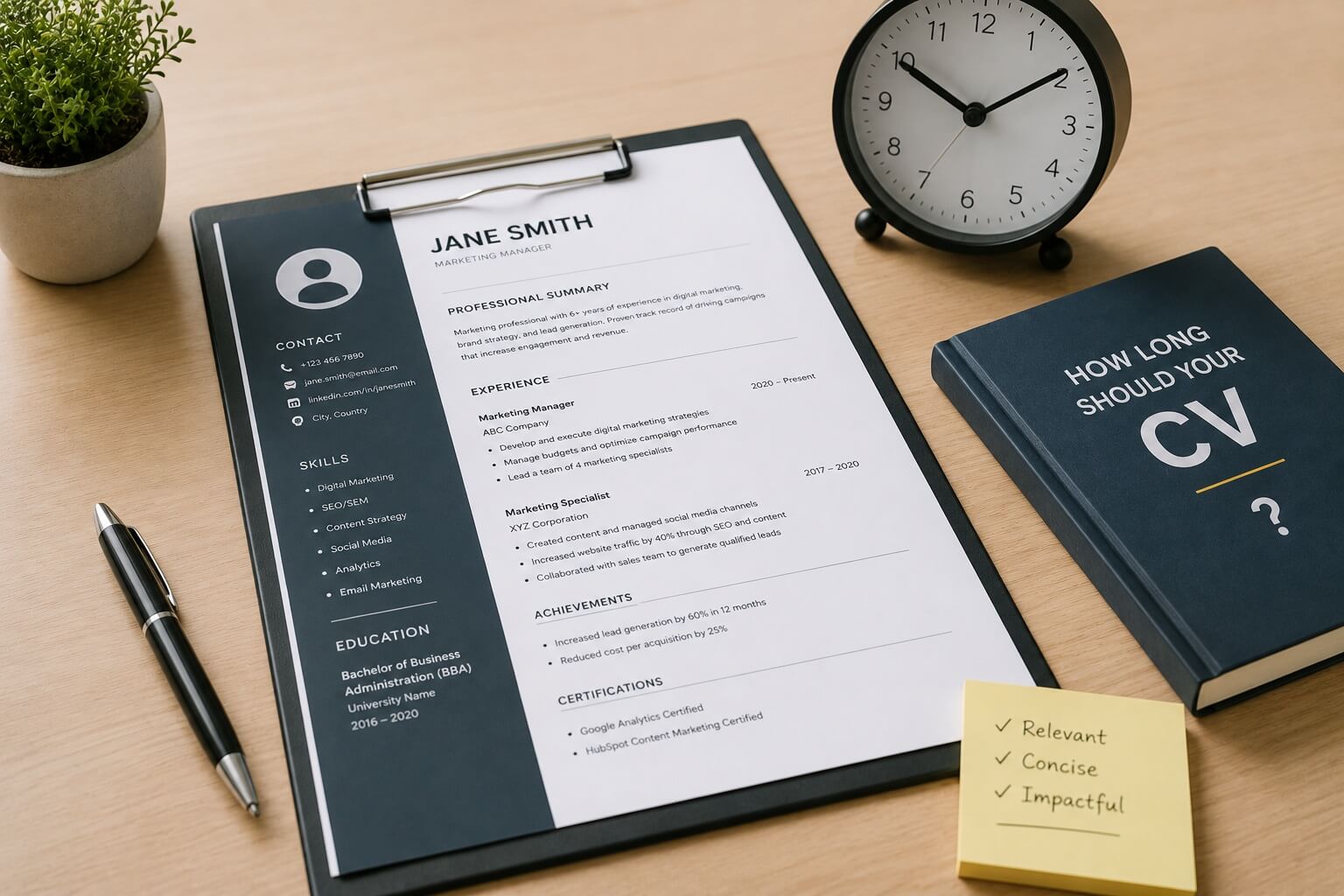
How long should a CV be? It is one of the most frequently asked questions in career advice, and it deserves a more nuanced answer than most people receive. The right CV length depends on your career stage, industry, and the specific role you are targeting. Here is the definitive guide by career stage so you can get your CV length exactly right.
Why CV Length Matters More Than You Think
Recruiters typically spend between six and thirty seconds scanning a CV before deciding whether to read it properly. A CV that is too long signals poor editorial judgement the candidate cannot prioritise. A CV that is too short can suggest a lack of substance or effort. Getting the length right is not just about word count; it is about demonstrating that you have curated your career story intelligently for the reader.
There is also the ATS factor. Applicant tracking systems parse CV content and may produce errors with overly dense or poorly structured documents. A well-proportioned CV appropriate length for your experience level consistently outperforms both extremes. According to research 77% of recruiters prefer a two-page CV for experienced candidates.
Graduates and Early-Career Candidates: One Page
If you are a recent graduate or have fewer than three years of professional experience, one page is the right target. At this stage, your CV should focus on your degree and relevant modules, any internships or work placements, extracurricular activities that demonstrate transferable skills, and projects or dissertations that showcase relevant ability.
You do not yet have the volume of experience that justifies a second page. Padding your CV with irrelevant detail to fill space is worse than keeping it concise and relevant. One strong, well-written page beats two weak ones every time. If you are struggling to fill even one page, see our dedicated guide on how to write a CV with no experience.
Mid-Career Professionals: Two Pages
Once you have three to ten years of relevant experience, two pages is the standard and widely expected. This gives you sufficient room to cover your most significant roles in detail, highlight key achievements with data, and include a well-developed skills section, without overwhelming the reader with unnecessary history.
At this stage, be selective. Not every role needs equal coverage. Focus on the last five to seven years and the experience most relevant to the role you are targeting. Earlier positions can be listed briefly with just dates, title, and company the reader’s attention should be on your recent work.
Senior and Executive Professionals: Two to Three Pages
Senior professionals, directors, and executives with ten or more years of experience may legitimately use two to three pages. At this level, recruiters expect a comprehensive account of significant leadership roles, strategic achievements, board experience, major transformation programmes, and relevant professional accreditations.
Even at this level, avoid going beyond three pages unless you are applying for an academic, research, or highly technical position where a longer document is a genre convention. Senior CVs should be long because the substance demands it not because every minor responsibility has been documented. For specific guidance on senior-level CVs, see our guide to writing an executive CV for C-suite and senior leadership roles.
What to Cut When You Are Over Length
If your CV is running too long, start with these cuts: remove roles older than fifteen years; cut redundant bullet points that repeat the same skill across roles; eliminate references to outdated technologies or qualifications no longer relevant to your target role; remove personal information that is not applicable in your target market (date of birth, marital status, nationality unless regionally expected). Every line must earn its place.
Also review your bullet point density. Many CVs run long not because they have too many roles, but because each role has too many bullets. Three to five strong, quantified bullet points per role is optimal for most mid-career positions. More than six risks diluting the most important achievements.
How Long Should a CV Be for a Career Change?
Career changers face a specific challenge: a long career history in the wrong field can overwhelm the transferable experience that is actually relevant. In this case, prioritise relevance over chronology. A functional or hybrid CV structure leading with skills and achievements rather than a strict reverse-chronological job list can compress your history to a manageable, targeted length. For more on this, see our guide to writing a career change CV.
Build the Right-Length CV
Getting length right is one of the first things SmartCV Builder helps you address. Our templates are designed for each career stage, and our guidance keeps you focused on what matters so you build a CV that is exactly as long as it needs to be, and no longer. Start building your CV with SmartCV today.