
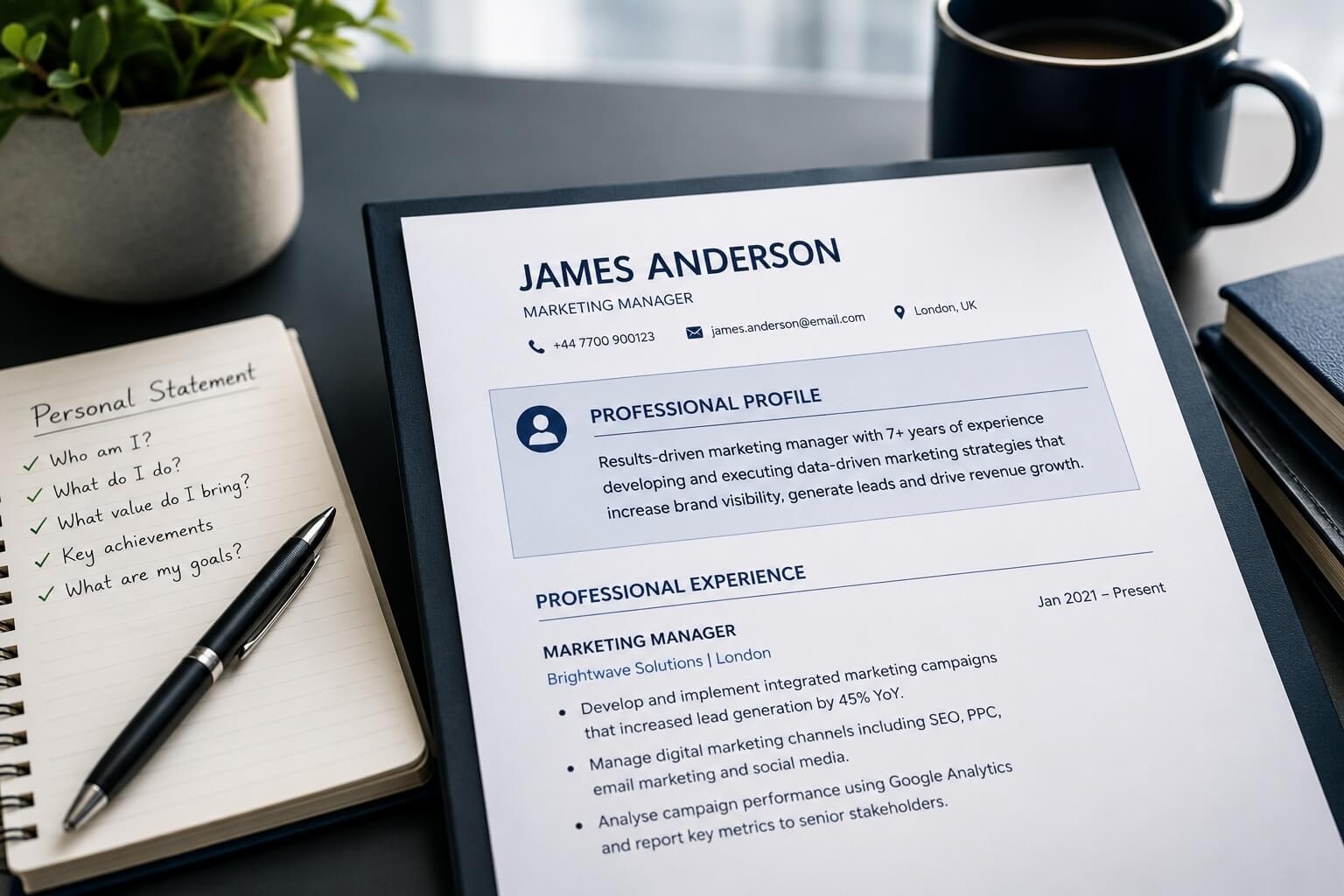
Your CV personal statement is the first thing a recruiter reads. It sits at the top of your CV, above your work history, and it does one job: convince the reader to keep going. Get it right and you earn their attention. Get it wrong and a strong career history may never be read.
Despite its importance, the CV personal statement is one of the most badly written sections on most CVs. It is either too vague, too long, or loaded with clichés that say nothing. This guide gives you a clear, step-by-step method to write one that is specific, compelling, and tailored to the roles you are targeting.
What Is a CV Personal Statement?
A CV personal statement (also called a professional profile, career summary, or personal profile) is a short paragraph at the top of your CV that summarises who you are as a professional. It typically runs three to five sentences and sits directly below your contact details.
Its purpose is not to repeat your work history. It is to contextualise it. A good personal statement tells the reader your seniority level, your specialism, your most relevant achievement, and what you are seeking next, all before they reach your first job entry.
Research by The Ladders found that recruiters spend an average of just seven seconds scanning a CV. Your personal statement is where those seven seconds begin.
How Long Should a CV Personal Statement Be?
Keep your CV personal statement to three to five sentences, roughly 60 to 100 words. Longer statements lose the reader before they reach your experience. Shorter ones fail to establish enough context.
Every sentence must earn its place. If you can remove a sentence without losing any specific information, remove it.
Step 1: Start With Your Professional Identity
Open your CV personal statement by naming exactly who you are professionally. Do not start with “I am a hardworking individual.” Start with your role and your seniority.
Examples of strong openers:
- “Senior marketing manager with seven years of experience in B2B SaaS growth…”
- “Chartered accountant specialising in financial reporting for FTSE 250 businesses…”
- “Data analyst with a background in healthcare and a track record in dashboard development…”
This single change immediately tells recruiters whether you are relevant and positions you in the right bracket before they read further.
Step 2: State Your Level and Specialism
After your opening identity line, be specific about your specialism. Generalist CVs consistently underperform against targeted ones. Recruiters are not looking for someone who can do many things. They are looking for someone who clearly matches their role.
If you are targeting a specific sector, name it. If you have a particular methodology or technical skill central to the roles you want, include it here. The CV personal statement is not the place for humility. It is the place for precision.
Step 3: Lead With a Quantified Achievement
One of the most effective things you can include in a CV personal statement is a single, concrete achievement with a number attached to it. This differentiates you from every candidate who uses adjectives instead of evidence.
Compare these two approaches:
❌ “A results-driven professional with a proven track record of delivering outcomes.”
✅ “Delivered a 34% reduction in customer churn over 18 months through a structured retention programme.”
The second version gives the reader a reason to read on. The first gives them nothing to anchor. For a full guide to writing achievement-led content throughout your CV, see our article on how to write CV bullet points that quantify your impact.
Step 4: Mirror the Job Description Language
ATS systems scan your CV personal statement before a human ever reads it. If the job description uses specific terminology and yours does not, you risk being filtered out regardless of how strong your experience is.
Read the job posting carefully. Identify the two or three most repeated phrases or requirements. Work them naturally into your CV personal statement. This does not mean copying wholesale; it means speaking the employer’s language.
For instance, if a role specifies “stakeholder management” and “cross-functional collaboration,” those phrases belong in your profile if they are genuinely part of your experience.
Step 5: Signal What You Are Looking For Next
The final sentence of your CV personal statement should briefly indicate what you are seeking. This helps recruiters immediately assess fit, and saves everyone time if the match is not right.
Keep it concise and role-relevant: “Currently seeking a senior product manager role within a growth-stage technology business.” This one sentence prevents your personal statement from feeling backward-looking and makes your intent explicit.
Step 6: Cut the Clichés
Certain phrases appear so frequently on CVs that they have lost all meaning. Remove them from your CV personal statement without exception:
- “Hardworking and dedicated”
- “Excellent communicator”
- “Team player”
- “Passionate about…”
- “Results-driven”
- “Dynamic and motivated”
None of these phrases is specific, verifiable, or differentiating. Every candidate uses them. Replace each one with a concrete detail: a number, a tool, a context, or a scope.
Step 7: Tailor It for Every Application
The single most common mistake professionals make with their CV personal statement is writing it once and sending it everywhere. A generic personal statement is immediately obvious to experienced recruiters and consistently underperforms.
At minimum, update three things for each application: your opening role description to reflect the exact title used in the job posting, the achievement you lead with to match the role’s priorities, and your final sentence to name the specific type of role and organisation you are targeting.
This does not need to take more than five minutes per application. For a full tailoring workflow, see our guide to why your CV is not getting interviews and how to fix it.
CV Personal Statement Examples
Here are three tailored CV personal statement examples across different career stages.
Graduate (no experience):
“Recent Economics graduate from the University of Leeds with a first-class dissertation on supply chain resilience. Completed a six-month placement at a logistics consultancy where I contributed to a client report that identified £2.3m in procurement savings. Seeking a graduate analyst role within supply chain or operations consulting.”
Mid-career professional:
“HR Business Partner with eight years of experience supporting 500+ employee workforces across retail and hospitality sectors. Reduced voluntary staff turnover by 18% over two years through a structured engagement and L&D programme. Seeking a senior HRBP or People Partner role within a consumer-facing business.”
Senior leader:
“Chief Operating Officer with fifteen years of operational leadership across scale-up and enterprise environments. Oversaw a transformation programme that reduced operating costs by £4.8m annually while improving customer satisfaction scores by 22 points. Open to COO, MD, or CEO roles within mission-driven businesses undergoing significant growth or change.”
For more on writing strong senior profiles, see our article on executive bio versus CV summary for senior leaders.
Common Mistakes to Avoid in Your CV Personal Statement
Beyond clichés, the following errors frequently weaken an otherwise strong CV personal statement:
- Writing in the first person: CVs are conventionally written in implied first person without “I.” “Senior developer with five years of experience” reads more cleanly than “I am a senior developer with five years of experience.”
- Exceeding five sentences: A long personal statement signals poor editing judgement, which is something recruiters notice.
- Referencing soft skills without evidence: Claiming to be “an excellent communicator” means nothing without context. Anchor any soft skill to a situation or outcome.
- Using the same version across different roles or sectors: A statement written for a marketing role reads poorly when sent for a project management position.
If your CV is fully written and you want a final quality check before applying, see our final CV checklist: five things to do five minutes before you hit apply.
Write Your CV Personal Statement With Smart CV Builder
Smart CV Builder guides you through every section, including your personal statement, with AI-powered suggestions, ATS scoring, and professional formatting built in. Build your CV now — it takes minutes.